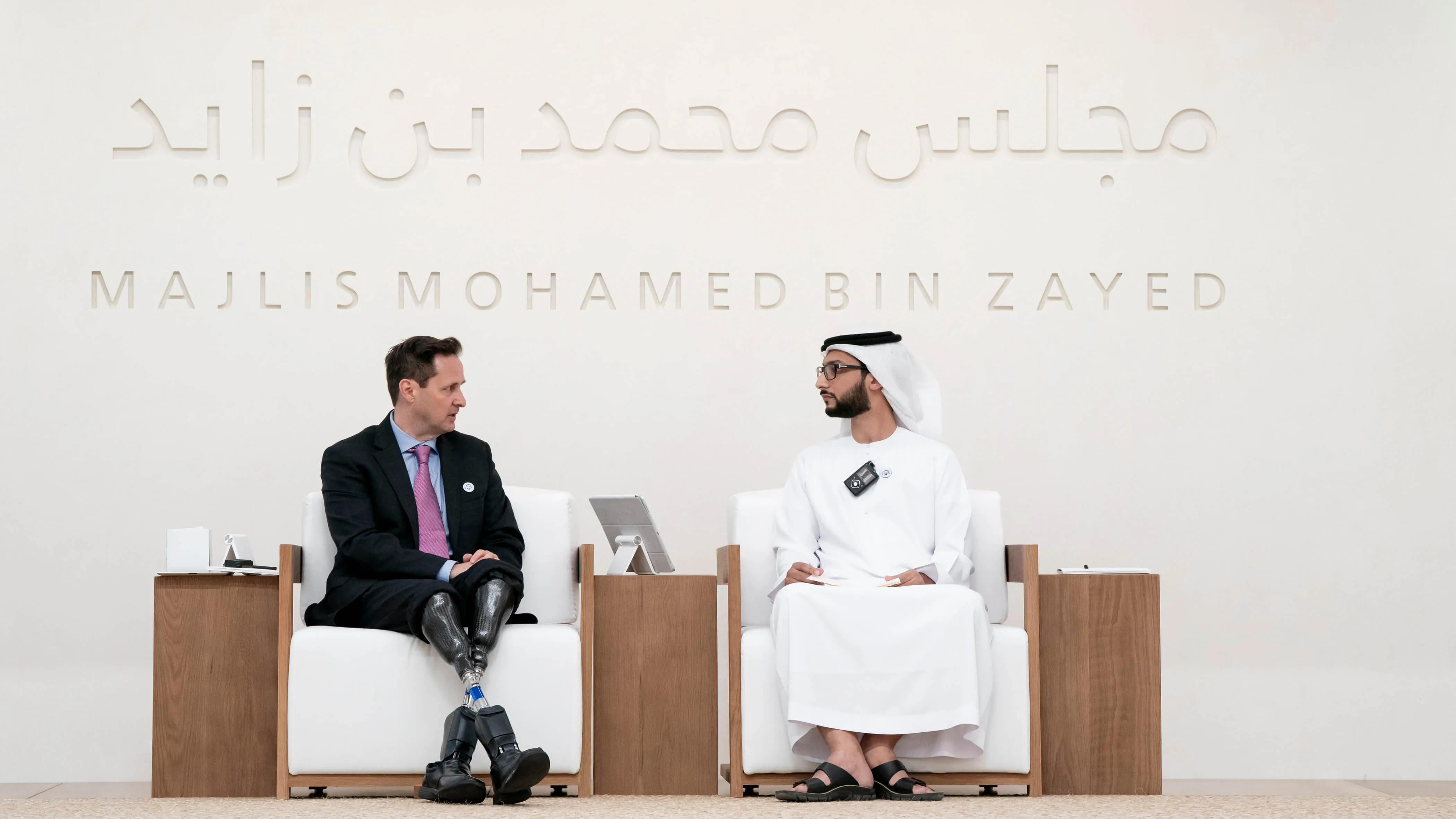
Also present were H.H. Sheikh Hamdan bin Zayed Al Nahyan, Ruler's Representative in Al Dhafra Region; Dr. Amal Abdullah Al Qubaisi, Speaker of Federal National Council (FNC); H.H. Sheikh Tahnoun bin Mohammed Al Nahyan, Abu Dhabi Ruler`s Representative in Al Ain Region; H.H. Sheikh Nahyan bin Zayed Al Nahyan, Chairman of the Board of Trustees of Zayed bin Sultan Al Nahyan Charitable and Humanitarian Foundation; H.H. Lt. General Sheikh Saif bin Zayed Al Nahyan, Deputy Prime Minister and Minister of the Interior; H.H. Sheikh Mansour bin Zayed Al Nahyan, Deputy Prime Minister and Minister of Presidential Affairs; H.H. Sheikh Hamed bin Zayed Al Nahyan, Chief of the Abu Dhabi Crown Prince's Court, as well as Sheikhs, diplomats and dignitaries.
Most people would have had their lives thrown into disarray after having both their legs amputated in a mountain-climbing accident at the age of 17. Instead, the indomitable Hugh Herr, a professor at MIT, refused to view his body as "broken", reckoning that technology might be broken but a human being can never "break". This motivated him to develop technology for the elimination of his own disability, and ultimately, that of others.
Herr’s efforts have resulted in the next generation of bionic limbs, robotic prosthetics inspired by nature's own designs, that allow us to run, climb and dance. Innovative technologies are helping merge bodies and machines, and the scientist is confident that the new bionics will help eliminate disability this century. Herr’s vision and pioneering talent were on display during Monday’s lecture, Advances in genetics, artificial intelligence, regenerative and reconstructive medicine, and robotics are beginning to enable more connections between the human body and machines, Herr said. Society is at the threshold of a new age when machines will be intimate extensions of the human body. Such a merging of body and machine will not only improve the quality of life for disabled people but will also allow persons with normal physiologies to experience augmented capabilities – cognitively, emotionally and physically. There soon will be a world where technology will merge with our bodies to forever change our concept of human capability.
From neural interfaces with the human nervous system, to bionic limbs that move like their biological counterparts, extreme bionics has global implications for improving the human condition.
Prof Herr’s immersion in robotics was driven by his quest to develop superior prosthetics. The scientist and his bio-mechatronics team have created augmentations that respond to subtle neural commands, with vastly improved fit and functionality. The team is creating robotic prosthetics that mimic the functions of real limbs, leading to a new bionic age.
The MIT lab is also working on projects that focus on treating paralysis, epilepsy, amputation and Parkinson’s disease through the development of bionic technologies.
These new research initiatives are capable of addressing a variety of conditions, from optogenetic approaches to the development of smart prostheses that can emulate and exceed the capabilities of biological limbs. By analyzing human motion, studying how electronic devices interface with the nervous system, and using live muscles to activate these devices, Prof Herr is fusing the nervous system with the built world. Herr’s work marries human physiology with electromechanics.
At the MIT lab, Herr and his team study how humans with normal physiologies stand, walk and run. They examine what the muscles are doing and how they are controlled by the spinal cord. They have built bionic ankles, knees and hips, which have been fitted to thousands of patients.
Herr, who co-directs the Center for Extreme Bionics at the MIT Media Lab, says his lab is also working on exoskeleton-like devices, which he predicts everyone will wear in the future to protect their limbs during activities like running. In a version made for people who aren’t missing limbs at all, the exoskeleton actually augments walking, applying torque and power as needed.
His team is working on a new type of limb that would receive not only commands, but sensations, from the central nervous system. This principle, which Herr calls neuro-embodied design, involves extending the human nervous system into synthetic body parts. Last year, a fellow mountain climber and old friend of Herr’s, Jim Ewing, became the first patient to undergo the new amputation process and get fitted with a cyborg-like synthetic limb.
He said over half of the world's population suffers from some form of cognitive, emotional, sensory or motor condition, and because of poor technology, these conditions often result in disability and a poorer quality of life. Every person should have the right to live life without disability, he says, adding that disability can now be transcended through technological innovation.